Finding Rest

NOTE: Scroll to the bottom of this post to find a very simple but important breathing practice you can try RIGHT NOW!

Last month I took a week off work for a couple of online continuing education workshops. In the same week, Sean and I decided to do an Ayurvedic Cleanse. We did it right around the Spring Equinox.

The Ayurvedic Cleanse we do is one I learned from a former yoga teacher and friend. We have done it almost every year for about 6 years . I have a packet and took a workshop on HOW to do the cleanse because it’s not necessarily a traditional diet. It’s not about losing weight. It’s a rest for your gut. IMPORTANT NOTE: I would NOT recommend doing this type of cleanse on your own without an Ayurveda trained professional guiding you through your first experience.

To prepare, you have to begin to ween yourself off caffeine. There is NO caffeine allowed for the 5+ days you do the cleanse. And I will tell you, when you ween yourself off, you realize what an addiction feels like on the VERY smallest of teeniest levels. It’s difficult and you can feel VERY sick if you do it cold turkey. Trust me I felt like I had the flu the first time I tried going without caffeine for longer than a couple of days. The cleanse itself is 5 days but you really need a full 10-12 days mapped out between preparing for the cleanse, doing the cleanse, and then coming back into your regular habits.

The cleanse is truly a gut reset. You eat the SAME THING for 5 days in a row. You use the SAME spices, even in your digestive tea. You can eat as much as you want, but there is NOTHING exciting about eating the same meal for 12 meals. Breakfast is a little different and even less exciting than lunch and dinner. All the spices and the food you eat is easy on the digestive track. You eat basmati rice and mung beans, always soaked overnight to make it even easier to digest. You drink a tea of cumin, coriander, and fennel seeds. You know you are deep in the cleanse when your entire house smells of cumin.

All this description is to tell you that when you do this cleanse, you should plan to REST. It’s low calorie. And the only movement you will probably even WANT to do is an easy walk, or some short restorative yoga poses that concentrate on digestion and relaxation. When you eat, you are full but not SATISFIED. That is the interesting thing about a monodiet. You get to eat, but the flavors are subtle. It’s low in salt. There is no sugar. Only a little honey and lemon in a cilantro chutney. For dinner you make dark leafy greens sauteed in coconut oil, turmeric, cumin seed (surprise!) and salt. It’s the most VIBRANT thing you will eat!

There is a struggle in eating without satisfaction. In eating to just nourish the body. I think it’s a worthy experience. I think of all the religions of the world that practice fasting. That practice is here with the Ayurvedic cleanse as well. When you eat, it is not for selfish reasons but for a journey back into appreciating our world, celebrating life, and slowing down from the everyday. It’s a rest.

I ended up resting my body for probably a full 10-14 days. I don’t usually do that. I love to move. It is my life-force. Before the cleanse I was fortunate to attend a workshop all about resetting the body’s nervous system. It was three days of practicing how to find conscious relaxation taught by Jill Miller of Tune Up Fitness®. The course, called Breath and Bliss®, was an exploration in how our BREATH is a true barometer of the state of our physical and mental body. Learning tools to help our breath turn down our sympathetic nervous system, when needed, and turn up our body’s ability to relax and rest.

Over the course of about 2 weeks, I gave my body permission to relax, I believe, because I had turned DOWN my sympathetic (flight or flight) system. I could truly enjoy resting because I was not feeling stressed about NOT working out. My body was already tuned into a more calm state. (Ok I had a few pouty days on the cleanse where I was REAL hungry, but I think that’s to be expected. By the last day I was fine).

We must rest. We must be able to hear when our bodies say it’s time to rest. We must get more sleep, we must say no to over scheduling, to jamming our days FULL. Rest can come in small ways. Like getting in bed in a little earlier, or saying I’ll take a walk today and enjoy the weather. Sometimes rest can be self massage, or a nice bath. A little yoga or a simple breathing practice. Maybe it’s a week at a beach or in the mountains, or just an afternoon on your porch without your phone in your hand. Take a few days off social media. (I promise nothing will happen while you are gone. LOL!)

NOW! Try this:

Taking away some of the noise of our lives can have a huge effect on our bodies. Simply stopping to breathe slowly for a few minutes a day is helpful.

Here is a simple breath practice you can do right now:

Find a comfortable position where you feel relaxed and silence your tech devices.

Try breathing in for 5 seconds, then breathing out for 5 seconds.

Practice this breath in and out through your nose.

Repeat this for 2 minutes.

You can keep your eyes open and gaze soft or close your eyes. Whatever feels most comfortable to you.

This breath pattern is probably slower than you breath normally. And we NEED to breath less. We breath too much. Breathing too much can put us in a stressed out state. Let’s not be so stressed!!! Maybe you breath through your mouth and don’t realize it. So catch yourself and close your lips lightly. Practice nasal breathing more and more through your day. It gets easier the more you practice. Just like anything in life! And be gentle with yourself as you practice!

Let me know how it goes and thank YOURSELF for taking a few minutes to take care of YOU!


Want to learn more techniques to help quiet the business inside you, calm your nervous system, and take some time to let go?

Sign up for my workshop R&R: Release and Relax, April 25, 2021 at 3pm EST!

Click below to sign up

Snow Joy

I don't know about you but I have felt cooped up. I tend to feel like this every February. And during a pandemic I think we all feel even more cooped up. I am thankful that I have not had to endure even a quarter of the hardships others are facing due to losing jobs, closing businesses, working and caring for kids at the same time, etc. And my heart goes out to everyone in Texas right now dealing with the extreme weather conditions and loss of power and water. Needless to say, t's an EXTRA TOUGH February for many right now.

For me, how I get out of that cooped up feeling is to walk. It's my meditation. It's my quiet place. It's what makes me happy. This happy place is different for everyone, but just that feeling of getting outside, for me, can completely change my mood.

My usual route has been completely covered in ice and snow. Sean had been telling me how icy the path has been, as he walks it every day. When I finally took time for myself and walked it, I began the walk by telling myself:
Oh, this is going to be hard.
This is going to take me longer than usual.
Maybe I'll turn back half way.
I don't like this.
I am too cold to walk.

And yes, it felt like all those things.

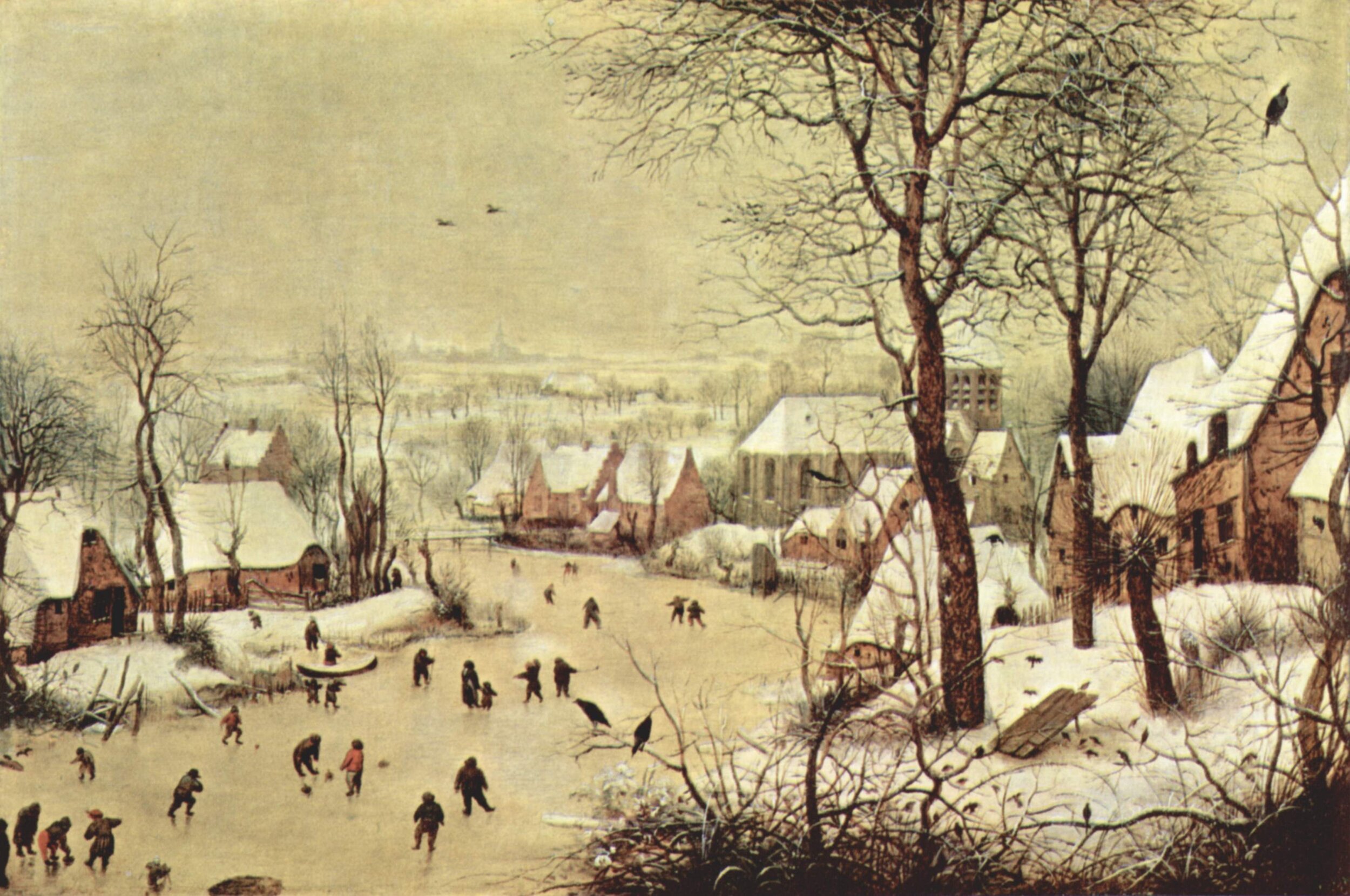
Then suddenly, once I had began to warm up and get comfortable with my pace, I paused and felt a moment of pure joy. The trail was beautiful. The sun was hitting the snow and making it sparkle. I was alone with just me and the birds chirping. People were sledding. It looked like a Bruegel Painting.

So I bring you back to what I was thinking at first and then what I suddenly realized as I was walking. I felt pure joy of the beauty around me. And when I realized that is what I felt, and what inspired me, my walk completely changed. My entire being changed. I felt lighter and happier. My slower walk helped me enjoy the scenery more. It was easier to walk because my thoughts didn't revolved around the negative but what was positive about this experience.

I will probably share more with you about the power of positive imagery in movement. But for now here is a little exercise you can try right now:

1. Lift your arm up and down.
2. Lift your arm up and think to your self: "My arm feels heavy like lead. I don't like doing this. This is boring."
3. Now lift your arm and think, my arm is as light as a cloud. This feels fluid and easy. My arm is floating up and down. I feel good."

Do you notice any difference?
How can you find a little joy this week?

"Winter Landscape with Ice Skaters and Bird Trap" -Bruegel

"Winter Landscape with Ice Skaters and Bird Trap" -Bruegel

Community Golf Course with Sledders -S. Honer

Community Golf Course with Sledders -S. Honer

Sitting, why we should do it more, but not on the couch.

This week I heard a great interview with Daniel Lieberman on his new book, Exercised, which is about why humans did not evolve to exercise but nonetheless it is healthy for us to do. The interview is about 30 minutes and he brings up great stuff on movement, why treadmills are kind of weird and not a natural way to walk, sitting and when chairs started to have backs on them and how that is linked to back pain. His years of research is congruent to many of the same concepts I talk to all of you about and what many of my own teachers have taught me.

My two cents on sitting. Dr. Lieberman gives an interesting history on when chair backs became a household item and a point he makes is that in indigenous cultures where he has done research, many of these people sit as long as we might. What he does NOT talk about is HOW these indigenous groups sit and WHAT they sit on. Most likely these people don't have access to our cushy couches and recliners. (In fact, as I write this, I just changed my position from writing on my couch to sitting on the floor with my laptop on the coffee table).

Anyway. HOW you sit for 6-8 hours can significantly affect your body. Seat backs allow us to RELAX out back muscles. Sitting without a seat back makes us USE our back muscles more. (Lieberman does a great explanation of back pain you can hear in the podcast. What I assume about these cultures Lieberman studies in remote parts of the world, is that they are sitting on the ground, maybe with pillows or the like for cushioning. What sitting on the ground does is make us MOVE more. Here in the states, we might sit for 6-8 hours and barely change positions because we are so cushioned and padded in our comfortable chairs. But think about times you have sat on the ground. Do you notice how "fidgety" you get? Sitting on the ground in fact STRENGTHENS our joints and muscles because we have to USE them to sit there and we have use to them to get up and down off the ground.

In his book Muscles and Meridians, Philip Beach writes that "Erecting ourselves from the floor is an essential tonic exercise that is a direct challenge to gravity." Beach writes that we spent our childhood learning to stand up against gravity. In our current lives, with our comfy chairs, our beds, and all the objects where we now find repose, we are only ever about halfway down to the ground. So we lose that extra strength it would have taken us to get up and down off the ground all day long, before these comforts were added to our lives.

Now I am not saying GET RID OF ALL YOUR FURNITURE AND SLEEP ON THE FLOOR! But if you are interested in transition to that type of lifestyle, Katy Bowman and Nutritious Movement have you covered. Much of what she teaches, and what I am trying to say here, is that just getting up out of our chairs, opting for sitting on the ground for a little while (use pillows and blankets and things! Doesn't have to just be sitting on the ground without padding), or practicing getting up and down off the ground (or even just practicing getting up and down from a chair, using the strength in your legs, if the floor seems too intimidating) is essential to keeping our bodies strong. Taking off our shoes, wiggling our toes more so our feet can FEEL the floor can help our entire body get stronger so we can FEEL more underneath us.

It's those little decisions throughout the day that can help us start to feel a little better, and start to help us feel stronger. So this week, if you find yourself sitting for a long time, just simply chose to get up more often, do that stretch you know you need, if the floor is accessible, sit on the floor, with pillows and things for a little while. You don't need to get rid of your furniture. We just have to chose to find new postures throughout our day.

On top of that, I don't want you to feel intimidated or bad about your own choices at home. What I hope we all can do is find ways to move that make us happy and not hurt so much. I hope that our work together can help you continue to do the things that make you happy. And choosing to wiggle around at home is a great way for us to continue to move and stay healthy!

If you want to start a transition to being able to sit on the ground more (and get back up off the ground), I can help you with techniques to get that to happen!

(Ps, now I’m on the floor on my stomach with a pillow, under my hips propped on my elbows typing). ;)

Listen to Podcast HERE

Let’s talk about Feet... Part 1

I am no doctor, but if one thing is tight in one area, you probably have something going on in a neighborhood nearby.

Ida Rolf would infamously say: “Where you think it is, it ain’t.”

So many times where pain shows up in our body has to do with a complex system of events that led to that pain. This week I want get to the root, the base, the bottom if it all…

OUR FEET!

Our feet have a direct correlation to what is happening above them.

Now, take a look at the shoes you tend to wear. Are they higher in the back? Yeah, of course heels are gonna be high. And they are gonna be cute. But look at your OTHER shoes. Your athletic shoes. your sandals. What kind of heel do they have on them?

ANY amount of lift at your heel is going to ask your muscles to adapt to the situation presented to them. Here are two examples:

 
See how this athletic shoe has an incline? It’s basically a more supportive version of the kitten heel seen to the right!

See how this athletic shoe has an incline? It’s basically a more supportive version of the kitten heel seen to the right!

Kitten heel. Cute? Sure. Good for your feet after walking around for hours at an event? Not so much…

Kitten heel. Cute? Sure. Good for your feet after walking around for hours at an event? Not so much…


I think one of the benefits of us having to work more from home is not having to wear shoes as often. Wearing shoes all the time is like having to wear a really stiff leather mitten all day long. It might protect our feet, especially in an environment where we need to not step on glass, or nails or whatever is in the street. BUT what it does NOT allow is for our hand (in this scenario) to be able to move as intricately as it could. Imagine trying to type, trying to write, or pick up something with a big mitten on all day. You would probably end up using more muscles in your forearm and lose a lot of muscle tone in your hands. Your hands would get stiff over the years. They might be tingly, achey, sore, swollen. And do we just chalk that up to “getting old”?

Now I am not saying THROW OUT YOUR SHOES!! GO BAREFOOT ALL DAY!! (but if you do that, cool!!!) What I am asking is for you to start to notice what you tend to put on the bottom of your foot. Our bodies are so incredibly adaptable. Wearing heels out to a restaurant where you are sitting is maybe a better option than at an event when you know you will be standing for long periods of time. (Of course “events” seem like a thing of the past these days…)

Guys, dudes, men!! This goes for you, too. Look at your dress shoes, how much of a heel is on them? That is going to affect your body as well!

One thing we can do to counteract the tightness we tend to feel after wearing shoes with heels is to simply stretch the backs of our legs. That includes our calves, hamstrings, and the soles of our feet.

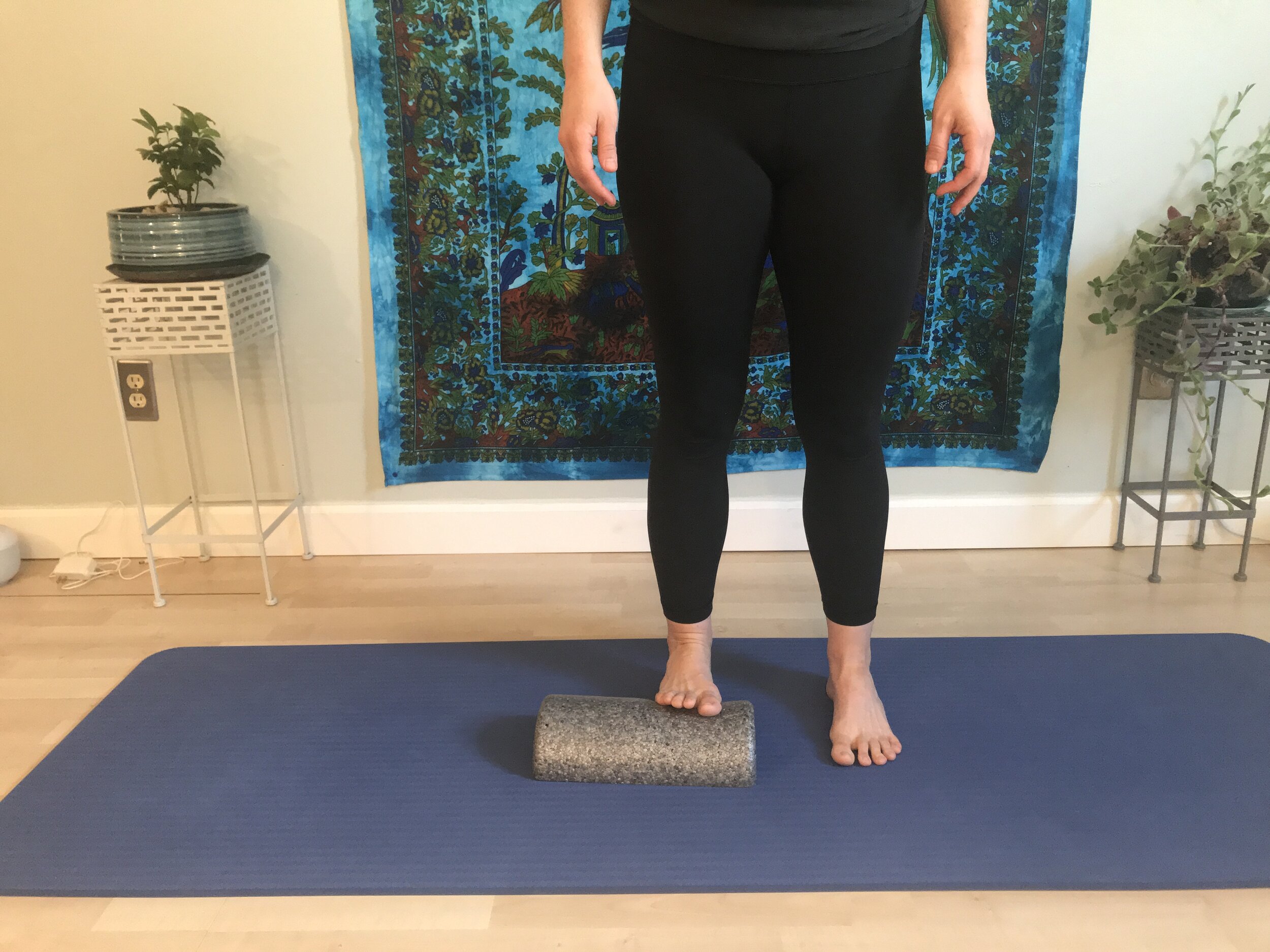
I love a calf stretch at the bottom of my steps, but here is another option: Grab a towel or roll up your yoga mat (pictured here is a half foam roller, aka half dome, which is also convenient as it is about the height we want to get a pretty good stretch at the back of the calf at about 2-3 inches high.

 
Side view with a half dome. Try this with  a rolled up bath towel at home. No fancy equipment required!

Side view with a half dome. Try this with a rolled up bath towel at home. No fancy equipment required!

 
Front view. Make sure your second toes are pointing straight ahead of you. Can you still wiggle your toes on the side you are stretching?

Front view. Make sure your second toes are pointing straight ahead of you. Can you still wiggle your toes on the side you are stretching?

Place the ball of one foot at the top of your towel or half dome. Bring the other foot beside the dome on the floor. Try to stand up straight without a banana back or tilting forward. Make sure your head is ontop of your shoulders, imagine your lungs are right over your hips, and your hips are right over the center of your feet, not behind or in front of them (refer to my previous blog post for your body alignment tips).

Next, see if you can step your other foot forward without compensating your alignment. And then do a test: Can you wiggle your toes of your foot on the dome? Can you stand up straight, like a describe above? If NOT, back up your other foot until you can. Basically we are finding the place where we start to feel the stretch. This is where we want to hang out. This ALSO tells you what the true length of your walking stride is without other stuff trying to help!! Pretty enlightening right?

As you can see here, my real walking stride is like 1 inch in front of my other foot!! Some of you may even have a NEGATIVE stance (the foot you aren’t stretching is BEHIND the one you are stretching). If your walking stride is short, that means your shins, your hip flexors and your low back are probably doing a lot to try to make up for the tightness in your calves and ankles to get you to go forward into the world. Your glutes may not be firing well to help propel you forward in space, and then we are basically just sort of falling forward and catching ourselves with every step! That’s Ok, just start to take your shoes off and do this stretch more!

It takes our muscles about 90 seconds-2 minutes to get the message that we want to change their length and normal patterning. So set a timer and see if you can stay in this stretch for at least 90 seconds on each leg. You can do this stretch multiple times per day. Use it as an excuse to get up out of your office chair (or your makeshift home office)!

Lastly, while you stretch, remember to breathe!!! Deeply and slowly!!

Bonus stretch:

Tops of your feet.

If the back of your calf is tight, that probably means the FRONT of your shin is doing a lot of work to get your foot to flex to strike your heel in front of you. Those poor shins and the top of your foot are probably tight. If you have had shin splints you KNOW what this feels like. But often we are walking around with tight shins and don’t even realize it!

Soooo. That means we should stretch the top of your foot too!

Start here to stretch the top of your foot. (You can multitask at your desk!!!)

Start here to stretch the top of your foot. (You can multitask at your desk!!!)

For a more advanced version,  you can try it standing with the “stretching” side knee bent.

For a more advanced version, you can try it standing with the “stretching” side knee bent.

Need MORE fun? Try it with both legs straight!

Need MORE fun? Try it with both legs straight!

Start seated in a chair, place the top of your foot on the floor, aiming to get all your toe nails on the ground. Make sure you don’t roll out onto your pinky toes with your heel out to the side, See if you can get on top of the big toe with your heel in line with your leg.

Try it standing, with the same idea, try to keep weight over your big toe and second toe. The tendency most likely will be to go over to that pinky toe because it’s easier there!

In the second picture you will see that my knee is still bent when I am standing. To make this even more advanced you can straighten the leg further back behind you, like the last picture to the right.

Let me know how it goes and tune in for my next post when I show you some self massage work you can do for your feet, calves and shins to begin to gain mobility back into your lower limbs!